

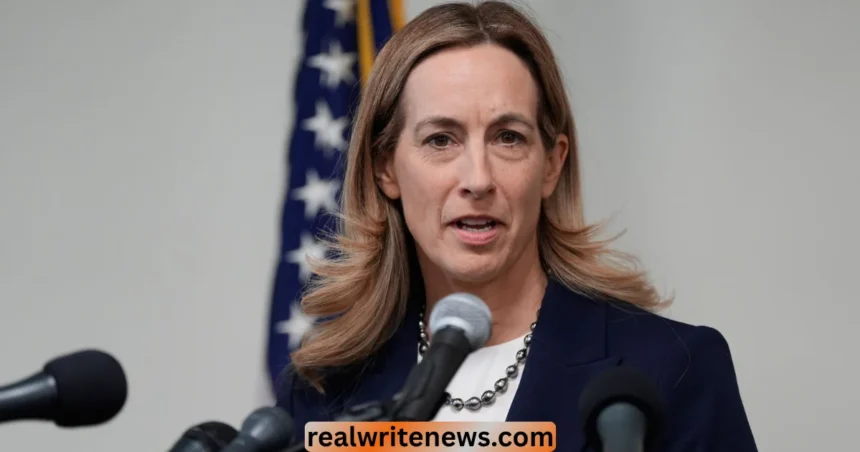
Mikie Sherrill rose from Navy helicopter pilot to federal prosecutor. Then she became a congresswoman. Today she is the 57th Governor of New Jersey. Her career has always centered on one promise: transparency and accountability. But within weeks of taking office, that promise came under fire. The reason is the Sherrill inaugural funding loophole. It is a legal gap. It let a nonprofit tied to her allies raise unlimited, undisclosed donations for her inaugural festivities. This article traces Sherrill’s biography, covers her historic 2025 election win, and breaks down the Sherrill inaugural funding loophole now testing her administration’s credibility. (For background on the office she now holds, see our guide to the New Jersey governor’s race.)
Who Is Mikie Sherrill?
Mikie Sherrill was born Rebecca Michelle Sherrill on January 19, 1972, in Alexandria, Virginia. She is an American politician, former naval officer, and former federal prosecutor. Today, she serves as the 57th Governor of New Jersey. She assumed office on January 20, 2026. Before politics, she built a career in public service. First came the military. Then came federal law enforcement. She is married to Jason Hedberg, also a Naval Academy graduate. The couple raises four children in Montclair, New Jersey. Her path from military aviator to governor helps explain why the loophole controversy struck such a nerve with her supporters.
Early Life and Education
Sherrill grew up moving along the East Coast. Discipline and service shaped her early path. She graduated from South Lakes High School in Reston, Virginia, in 1990. In 1994, she earned a B.S. from the United States Naval Academy. She was part of the first class of women eligible for combat roles on ships and aircraft. A Master’s degree from the London School of Economics followed in 2003. She earned a J.D. from Georgetown University Law Center in 2007. This layered education spanned the military, international relations, and law. Together, these experiences shaped the moderate, service-oriented identity she later brought to Congress and the governor’s office.
Military Service in the U.S. Navy
From 1994 to 2003, Sherrill served as a Sea King helicopter pilot in the U.S. Navy. She reached the rank of lieutenant. She led missions across Europe and the Middle East. During the Iraq War, she worked the Battle Watch Floor as a flag aide to a deputy commander. Her nearly decade-long naval career became central to her political brand. It reinforced an image of duty and integrity. That reputation is exactly why critics say the loophole controversy feels jarring. A candidate who built her identity on service and transparency now faces questions about donor secrecy around her own inauguration.
From Federal Prosecutor to Congresswoman
After the Navy, Sherrill practiced law privately. In 2012, she joined the U.S. Attorney’s Office for the District of New Jersey. She first worked as an outreach and reentry coordinator. In 2015, she became an Assistant U.S. Attorney. She prosecuted federal cases and worked to remove illegal firearms from New Jersey communities. This prosecutorial background gave her credibility on law-and-order issues. It became a recurring talking point throughout her political rise. It also raised expectations that she would hold herself to strict standards of accountability. Those are the same expectations now being tested by the loophole controversy bearing her name.
The 2018 Congressional Election
In 2018, Sherrill entered electoral politics. New Jersey’s 11th Congressional District seat had just opened up. She defeated Republican Jay Webber with more than 56% of the vote. In doing so, she flipped a traditionally Republican district blue. She became one of over 100 women elected to Congress that year. It was a wave that reshaped the House’s composition. In Congress, she served on the House Armed Services Committee. There, she worked on subcommittees focused on tactical air forces and cyber policy. This record built her reputation as a pragmatic, security-minded legislator ahead of her eventual run for governor.
Life in the “Mod Squad”
Once in Congress, Sherrill aligned with a group of moderate Democratic women. Many had national security backgrounds. The group became known informally as the “Mod Squad.” It included Abigail Spanberger of Virginia and Elissa Slotkin of Michigan, both former CIA officers. Notably, in 2025 both Sherrill and Spanberger ran for governor in their respective states. This network of moderate, service-background Democrats boosted Sherrill’s national profile. It also gave her a template for running a disciplined, centrist gubernatorial campaign built heavily on promises of clean governance.
The 2025 New Jersey Governor’s Race
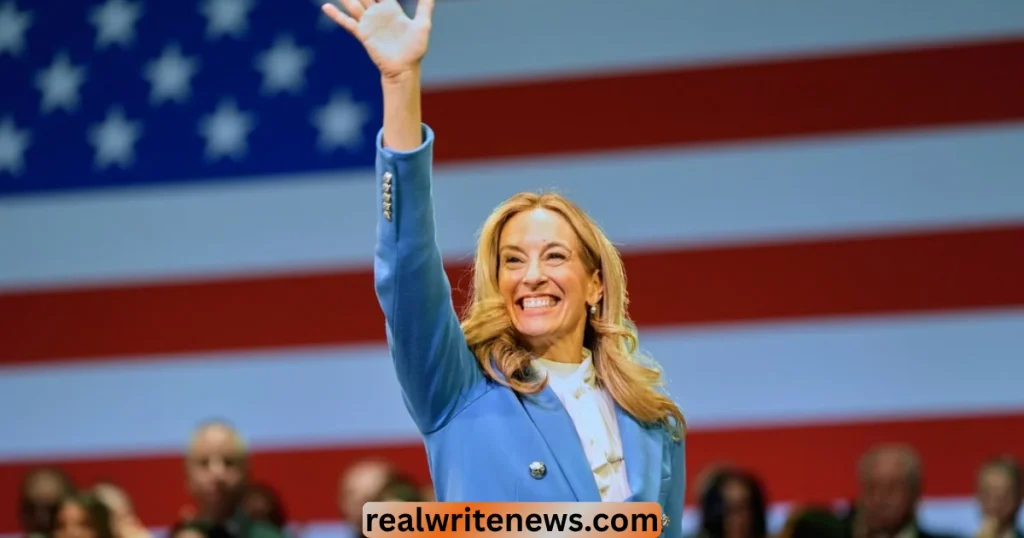
Sherrill resigned from Congress on November 20, 2025, after winning the New Jersey governorship. She was sworn in as governor on January 20, 2026, succeeding Phil Murphy. Her win marked a historic moment. It was the first time since 1961 that New Jersey voters elected the same party for three consecutive gubernatorial terms. Throughout the campaign, Sherrill emphasized affordability and government accountability. She also spoke often about getting “dark money out of politics.” That phrase would later resurface pointedly, once the inaugural funding loophole controversy became public.
Defeating Jack Ciattarelli
On November 4, 2025, Sherrill defeated Republican Jack Ciattarelli, according to Ballotpedia’s election results. The margin was decisive: 56% to 43%. Lieutenant Governor-elect Dale Caldwell joined her on the winning ticket. In her victory speech, Sherrill promised to “hold government accountable, balancing individual liberty with collective responsibility.” That rhetoric set a high bar for her incoming administration. It also made the fundraising controversy that followed feel especially consequential to transparency advocates watching her first weeks in office.
A Campaign Built on Transparency
Sherrill’s campaign consistently promoted a platform of “transparency and accountability.” She frequently criticized undisclosed political spending. She positioned herself as a reformer willing to close loopholes that let money influence government without public scrutiny. This messaging became central to her appeal among moderate and independent voters. It is also the exact standard the Sherrill inaugural funding loophole is now measured against. The arrangement funding her own inaugural events fell short of full public disclosure.
Show Image
Understanding the Sherrill Inaugural Funding Loophole
At the center of the controversy is Mission to Deliver NJ. It is a 501(c)(4) “social welfare” nonprofit created by Sherrill’s allies. Its purpose was to fund inaugural festivities and related events. Unlike the official inaugural committee, this nonprofit is not bound by New Jersey’s contribution limits. It also has no legal duty to publicly disclose its donors. That gap is the essence of the Sherrill inaugural funding loophole. It is a legal, long-used mechanism. It lets allied nonprofits raise essentially unlimited money around a governor’s inauguration, while keeping the donor list largely hidden from the public.
What Is Mission to Deliver NJ Under the Sherrill Inaugural Funding Loophole?
Mission to Deliver NJ was organized specifically to support Sherrill’s inaugural events, according to POLITICO’s reporting. As a 501(c)(4), it operates under IRS rules meant for social welfare organizations, not campaign finance rules. That distinction matters enormously. Candidate committees and official inaugural committees face strict caps and disclosure requirements. Affiliated 501(c)(4) groups do not. Fundraising solicitations reviewed by POLITICO showed the organization actively pursuing large checks. Business executives, lobbyists, and union leaders were among the targets, all eager for access to the incoming administration.
How the 501(c)(4) Loophole Works
501(c)(4) organizations are not classified as political committees. That status lets them escape New Jersey’s $500 cap on inaugural contributions. Donors can give hundreds of thousands of dollars. Often, neither the amount nor the donor’s identity becomes public record. Campaign finance experts describe this as a structural gap, not a Sherrill-specific scheme. Similar organizations have funded inaugural events for governors in numerous states. Still, the scale and secrecy in Sherrill’s case drew significant scrutiny, given her explicit campaign promises around dark money.
The $100,000 Dinner That Exposed the Sherrill Inaugural Funding Loophole
Five days before her swearing-in, Sherrill attended a ritzy dinner at Carpaccio. It is an Italian restaurant inside the American Dream mall in East Rutherford, New Jersey. Champagne bottles there reportedly sold for $600. The minimum donation to attend was $100,000, according to two people familiar with the event cited by POLITICO. Attendees reportedly included business executives, lobbyists, and union leaders. They moved table to table, speaking directly with the incoming governor. Transparency advocates warn this is exactly the kind of access that can create the appearance of influence-buying.
The “Commander” Donor Tier
Donors who contributed over $250,000 reportedly received the top “Commander” tier of benefits. That tier included four tickets to the pre-inaugural dinner. It also included a seat on the nonprofit’s finance committee and quarterly briefings from top state officials, according to the Daily Caller’s coverage of Politico’s reporting. These tiered perks show how the funding structure worked. It was less a simple donation drive and more a structured, high-dollar access program. Critics ask a pointed question: who bought this level of proximity to New Jersey’s new governor, and why won’t the public know?
New Jersey’s $500 Inaugural Contribution Cap
New Jersey state law caps direct contributions to official inaugural committees at $500 per donor. The rule exists to prevent wealthy interests from buying outsized influence over an incoming administration. But this cap only applies to the official inaugural committee itself. Mission to Deliver NJ operated as an independent 501(c)(4), not the official committee. So it was not bound by that $500 limit at all. This distinction is the legal foundation of the entire loophole. It explains how six-figure donations could flow entirely outside the spirit of the state’s inaugural finance restrictions.
Reactions From Transparency Advocates
The arrangement drew sharp criticism from campaign finance watchdogs. Saurav Ghosh, director of federal campaign finance reform at the Campaign Legal Center, said such donations are “unlimited and dark.” He noted the public has no way of knowing who may be seeking influence with a new administration. Ordinary New Jersey residents, he said, have no visibility into who helped bankroll the celebrations surrounding their new governor’s inauguration. Advocates argue that even legal practices can undermine the spirit of campaign finance limits. Voters generally assume those limits protect them from concentrated, secret influence.
Campaign Legal Center’s Concerns
Beyond Ghosh’s comments, transparency groups make a broader argument. They say 501(c)(4) inaugural funding vehicles are a growing pattern nationwide, not just in New Jersey. Their concern isn’t only about Sherrill personally. It’s about a systemic weakness in campaign finance law. Governors across party lines have used similar tools. Donors can remain anonymous indefinitely. That leaves the public unable to evaluate potential conflicts of interest. This matters most when a new administration later makes regulatory or contracting decisions that could benefit major donors, often identified only through leaked documents or investigative reporting.
Is the Sherrill Inaugural Funding Loophole Unique to Her?
Not everyone frames this as unique to Sherrill. New Jersey transparency attorney C.J. Griffin said, “I don’t see it as a Governor Sherrill issue.” She pointed out that similar nonprofit structures have funded gubernatorial inaugurations at both the state and federal level for years. This view suggests the Sherrill inaugural funding loophole reflects a longstanding, bipartisan feature of American political fundraising. It is not a scandal unique to one administration. Still, critics counter that the gap between Sherrill’s anti-dark-money rhetoric and her own fundraising practices makes her case a particularly visible example of the broader problem. (See our related coverage of dark money in state politics for more context.)
Sherrill’s Response and Transparency Pledge
Representatives connected to Mission to Deliver NJ, including spokesperson Mick Lozano, addressed the criticism. They indicated the group would eventually disclose donations of up to $500. But they do not plan to exceed the IRS’s minimum disclosure requirements, since the group does not consider itself a political organization. This response highlights a tension. It sits between technical legal compliance and the broader transparency standard Sherrill campaigned on. Good-government advocates argue that voluntary, partial disclosure falls short of the “dark money out of politics” language Sherrill used repeatedly before taking office.
Comparing State and Federal Inaugural Funding Rules
Inaugural funding loopholes are not unique to New Jersey. At the federal level, presidential inaugural committees have faced similar criticism. They too have accepted large, sometimes only partially disclosed, corporate donations. Many states allow comparable nonprofit vehicles. These groups fund inaugural balls, dinners, and receptions outside standard campaign contribution limits. Legal experts say closing these loopholes would likely require new state legislation. That legislation would need to specifically target 501(c)(4) organizations affiliated with elected officials. Existing campaign finance law was written with candidate committees in mind, not nonprofit fundraising arms formed around a single inaugural event.
What This Means for New Jersey Voters
For everyday New Jersey residents, the practical impact is limited transparency. It affects who has early access and potential influence with the new governor’s office. No evidence has emerged of illegal activity. But the arrangement raises questions about whether major donors could receive preferential treatment later. That could include regulatory, contracting, or policy matters down the road. Watchdog groups argue that voters deserve to know who funded their governor’s celebratory events. This matters especially since that governor explicitly promised to root out undisclosed political money during her campaign.

Sherrill’s Early Governance and Policy Agenda
Despite the funding controversy, Sherrill moved quickly on policy after taking office. Her administration has focused on affordability, education funding, and infrastructure. These themes continue directly from her campaign. Her early record offers useful context for a bigger question. Will the Sherrill inaugural funding loophole meaningfully affect her governance, or will it fade as a one-time news cycle? That question looms larger as her administration rolls out major budget and infrastructure priorities in its first months. (Read our full breakdown of Sherrill’s affordability agenda for more.)
The $60.9 Billion State Budget
In March 2026, Sherrill unveiled a record $60.9 billion first budget, according to Morristown Green. It closed what she described as corporate tax loopholes, including capping deductions for net operating losses. The budget included a $372 million increase for K-12 schools. It added $213 million more for public transportation. It also included roughly $2 billion in cuts, including a $500 million reduction to the StayNJ senior property tax relief program. Her framing of closing “tax loopholes” for revenue purposes stands in ironic contrast. Critics note it sits alongside ongoing criticism over the inaugural funding loophole benefiting her own political network.
Clashing With Washington Over Gateway Tunnel Funding
Sherrill also quickly clashed with the federal government. She called President Trump’s funding freeze on the $16 billion Gateway Tunnel project an “illegal attack” on New Jersey. She warned the freeze could cost nearly 100,000 jobs. It could also cost $20 billion in economic activity. This high-profile confrontation showed Sherrill’s willingness to fight publicly for state interests. At the same time, she faced questions at home about the transparency of her own inaugural fundraising operation.
Conclusion
Mikie Sherrill’s journey from Navy pilot to federal prosecutor to New Jersey’s governor is a genuinely historic political story. Yet her early tenure has been shadowed by the Sherrill inaugural funding loophole. It is a legal but controversial arrangement. It let allies raise unlimited, largely undisclosed donations through a 501(c)(4) nonprofit for her inaugural events. Experts note this loophole is not unique to her administration. But the contrast with her campaign promises of transparency and eliminating dark money has made it an early test of credibility. How Sherrill responds to continued scrutiny may shape public trust in her administration far beyond the inaugural season itself.
Frequently Asked Questions
1. What is the Sherrill inaugural funding loophole? It refers to the use of a 501(c)(4) nonprofit, Mission to Deliver NJ, to raise unlimited and largely undisclosed donations for Governor Mikie Sherrill’s inaugural events. It bypassed New Jersey’s $500 cap on official inaugural committee contributions.
2. Is the inaugural funding loophole illegal? No. Legal experts and transparency attorneys say the practice is legal under current IRS and state campaign finance rules. It is, however, widely criticized as lacking transparency.
3. How much could donors contribute through this loophole? Reports indicate some donors gave over $250,000. That far exceeds New Jersey’s $500 legal cap on direct inaugural committee contributions.
4. Will the donor list ever be made public? A spokesperson said the group would disclose donations up to $500. It does not plan to exceed minimum IRS disclosure requirements, so larger donors may remain anonymous.
5. Is this loophole unique to New Jersey or Mikie Sherrill? No. Transparency advocates note that similar nonprofit structures have funded gubernatorial and presidential inaugurations in many states for years.
6. What was Mikie Sherrill’s career before politics? She served nearly a decade as a U.S. Navy helicopter pilot. She then worked as a federal prosecutor in New Jersey before being elected to Congress in 2018.
7. When did Mikie Sherrill become governor of New Jersey? She was elected on November 4, 2025. She was sworn in as the 57th Governor of New Jersey on January 20, 2026.