

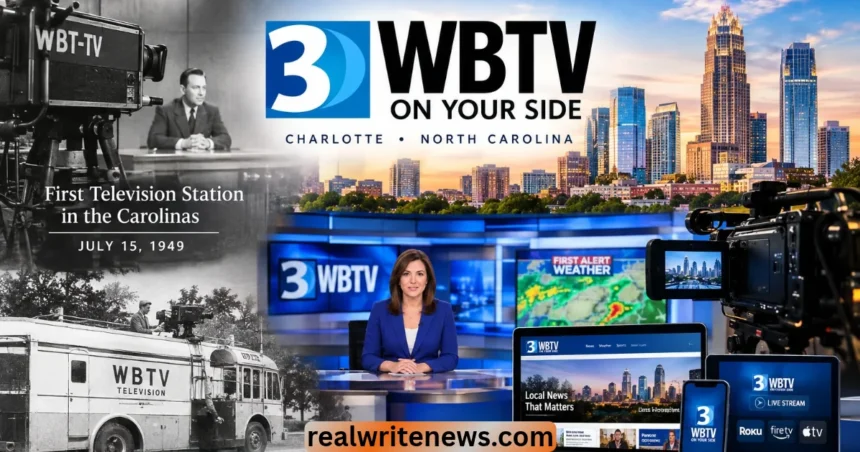
WBTV is a historic television station based in Charlotte, North Carolina, and one of the most recognizable local broadcasters in the Carolinas. The station first went on the air on July 15, 1949, becoming the first television station in the Carolinas. Today, WBTV operates as Channel 3 in the Charlotte market and provides local news, weather, sports, community reporting, CBS programming, and digital content.
Unlike a biography about a person, a WBTV biography is really the story of a broadcast institution. Its history follows the development of television itself, from early test patterns and live broadcasts to modern websites, mobile applications, streaming, and social media. This article explores WBTV’s origins, important milestones, journalism, technology, community role, ownership, and current digital presence.
WBTV at a Glance
| Fact | Details |
|---|---|
| Station | WBTV |
| Channel | Channel 3 |
| Location | Charlotte, North Carolina |
| First Broadcast | July 15, 1949 |
| Network | CBS |
| Owner | Gray Media |
| Original Parent | Jefferson Standard Broadcasting |
| Historic Significance | First television station in the Carolinas |
| Coverage | Charlotte region, NC Piedmont and surrounding areas |
| Slogan | “On Your Side” |
WBTV’s official site currently identifies the station as a Gray Local Media Station and lists its Charlotte address at 1 Julian Price Place.
The Meaning Behind the WBTV Name
The name WBTV represents a station whose roots are closely connected to Charlotte’s long broadcasting history. Before television arrived, WBT Radio had already established itself as an important broadcaster in the Carolinas. WBTV grew from that broadcasting tradition when television became a new form of mass communication after World War II. The station initially used the call sign WBT-TV before the name was changed to WBTV in May 1949. Jefferson Standard announced that scheduled programming would begin on July 15 of that year.
That connection with WBT Radio gave the new television operation access to experienced broadcasters and established personalities. Over time, WBTV developed its own identity while maintaining a strong connection to the Charlotte community.
WBTV’s Historic Launch in 1949
The most important date in the WBTV story is July 15, 1949. At noon that day, the station officially signed on. Viewers saw the American flag and heard the “Star-Spangled Banner” before announcer Jim Patterson introduced the station and its evening programming. WBTV’s first broadcast made it the first television station in the Carolinas and one of the earliest television stations in the United States.
Television was still unfamiliar to most families. The station initially had very limited equipment, and only about 1,000 television sets were estimated to be in the Carolinas when WBTV began broadcasting. Within months, television ownership grew rapidly. The station therefore entered a market that was changing almost as quickly as its technology.
The First Programs on WBTV
The first night of programming demonstrated how different television was in the late 1940s. WBTV presented its own news material followed by network entertainment and a movie. The schedule included The Cliff Edwards Show, Believe It or Not, the Charlotte Rotary Boys Choir, and the film A Star Is Born.
During its first year, WBTV often used test patterns, time and temperature information, news announcements, and filmed programs. Television viewers gradually became familiar with the idea of receiving both pictures and sound inside their homes. According to WBTV’s historical record, the number of television sets in the area grew from roughly 1,000 at sign-on to thousands more by the end of 1949.
WBTV and the Growth of Television News
Local news became one of the most important parts of the WBTV identity. In 1952, the station introduced regularly scheduled news programming known as “The Esso Reporter.” The program was anchored by Doug Mayes, with weather and sports contributors helping create a format that resembles the structure of local television news today.
Mayes became an important figure in Carolinas broadcasting and is described in WBTV’s historical material as the first television anchorman in the Carolinas. At the time, television news was still a new concept. There were no modern satellite trucks, social media feeds, smartphones, or digital editing systems. Reporters and technicians worked with comparatively basic equipment while developing many of the conventions that later became standard in television journalism.
Early Live Broadcasts and Network Connections
Technology quickly expanded what WBTV could broadcast. In September 1950, the station carried its first live network program through a coaxial cable connection. The broadcast was a college football game between North Carolina and Notre Dame from South Bend, Indiana. Notre Dame won the game 14–7.
This development mattered because viewers were no longer limited to locally produced or filmed programming. Live network television allowed Charlotte audiences to see events taking place hundreds of miles away. WBTV continued expanding its live capabilities, including local programming and remote broadcasts. These developments helped transform the station from a new experimental broadcaster into a significant regional television operation.

WBTV’s Mobile Television Truck
One of the station’s early technological milestones came in 1952, when WBTV introduced a $75,000 mobile television truck. The vehicle carried cameras, monitors, replay equipment, cables, lighting equipment, and spare parts. It allowed the station to take television production outside its studio.
Mobile broadcasting became especially important for political events, sports, public gatherings, and special programs. WBTV’s early investment in remote production demonstrated how quickly television was moving beyond fixed studio broadcasts. The concept also established a tradition that remains important today: local stations need to reach audiences where events are happening rather than waiting for stories to come to the newsroom.
WBTV and the Introduction of Color Television
Another major chapter in WBTV history involved color television. The station began transmitting color test patterns in May 1954, making it an early pioneer in color broadcasting in the southeastern United States. WBTV’s historical record also describes its later work with regular local color programming and color videotape.
The transition from black-and-white television to color represented a major technological change. Viewers could experience local personalities, entertainment programs, news, and special events with greater visual detail. WBTV continued experimenting with television production technology as the industry moved toward more sophisticated cameras, recording systems, studios, and transmission equipment.
Famous Personalities in WBTV History
The story of WBTV is also the story of the broadcasters who became familiar faces and voices throughout the Carolinas. Among the personalities associated with its early years were Jim Patterson, Doug Mayes, Clyde McLean, Betty Feezor, Loonis McGlohon, Fred Kirby, and Arthur Smith.
These personalities worked in different areas, including news, weather, entertainment, music, and lifestyle programming. Their popularity helped television become a personal medium. Viewers did not simply watch programs; they developed familiarity with the people appearing on screen every day. Some WBTV personalities became closely associated with Charlotte broadcasting for decades.
WBTV’s Connection With CBS
WBTV has also maintained a long relationship with CBS programming. The station’s early history includes network programs arriving through increasingly sophisticated transmission systems. Over the decades, CBS programming became an important part of the station’s broadcast schedule alongside locally produced news and community programming.
Today, WBTV continues to carry CBS programming on Channel 3 while producing its own local news and other programming. Its current online information explains that CBS shows are part of the Channel 3 schedule, while the station’s internet streams focus primarily on WBTV-produced programming and newscasts.
WBTV and Charlotte Local News
Local journalism remains at the center of WBTV. The station covers Charlotte and communities across the surrounding region, with reporting that includes breaking news, weather, traffic, public safety, education, business, politics, sports, and community events. Its long history has made it a recognizable source of local television news for generations of viewers.
The station’s historical material describes its mission in terms of serving the community and providing information across multiple platforms. Modern WBTV is no longer limited to a television screen. News stories can appear on the station’s website, mobile applications, streaming platforms, and social channels, allowing audiences to access information throughout the day rather than waiting for a scheduled newscast.
The “On Your Side” Identity
The phrase “On Your Side” has become strongly associated with WBTV. The station has used the identity to describe its relationship with viewers and its approach to local journalism. In a 2017 editorial, WBTV explained that the phrase was intended to communicate a community-focused relationship rather than a political position.
That distinction is important because a local television station serves a broad audience with different opinions and backgrounds. WBTV’s stated editorial approach emphasizes reporting facts and providing information while recognizing that viewers can have different perspectives. Its journalism therefore forms part of the station’s broader effort to remain connected with the Charlotte community.
WBTV and Community Service
Community involvement has been another recurring part of the WBTV story. Historical records describe telethons and fundraising efforts supporting organizations and community causes. WBTV has also participated in public-service campaigns and special broadcasts during major regional events.
This community role reflects the traditional importance of local television stations. A local broadcaster can provide more than daily headlines. It can connect viewers with charitable organizations, public safety information, severe-weather updates, educational resources, and community events. Over the decades, WBTV has continued this role while changing the technology used to reach its audience.
WBTV During Hurricane Hugo
One of the most notable examples of WBTV’s role during a major emergency came during Hurricane Hugo in 1989. According to WBTV’s historical anniversary material, the station remained on the air using generators after the hurricane struck the region. This allowed people with battery-powered televisions to continue receiving information during a major disaster.
Emergency broadcasting demonstrates why local television can remain important even as technology changes. During severe weather or other emergencies, audiences need timely information about conditions, roads, shelters, power outages, and public safety. WBTV’s history shows how maintaining broadcast operations during a crisis became part of its local-service responsibility.
WBTV’s Move Into the Digital Era
The 1990s and 2000s brought another major transformation. Television stations increasingly adopted computerized newsrooms, digital production, websites, online video, and expanded newscasts. WBTV was part of that transition and gradually developed a larger digital presence alongside its traditional broadcast operation.
The modern WBTV website provides breaking news, weather information, live video, articles, videos, programming information, and other digital features. This approach allows the station to publish information continuously rather than only during scheduled television broadcasts. The change reflects the wider transformation of local journalism, where audiences increasingly expect news to be available whenever they need it.
WBTV’s Current Streaming and Mobile Services
Today, WBTV reaches viewers through traditional television and several digital platforms. Its current schedule includes multiple daily WBTV News broadcasts, QC Life, and On Your Side Tonight. The station also provides live streaming through its website and free mobile and streaming applications.
WBTV explains that when its locally produced programming is live, viewers can watch through the online player. The station also offers streaming applications for devices and platforms including Roku, Fire TV, and Apple TV, in addition to its mobile app. This gives WBTV a presence beyond traditional Channel 3 television.
Who Owns WBTV Today?
The ownership history of WBTV has changed over the decades. The station was originally connected to Jefferson Standard Broadcasting and later became part of Raycom Media. In January 2019, Gray completed its acquisition of Raycom Media, bringing WBTV into the Gray portfolio.
WBTV’s current website identifies itself as a Gray Local Media Station, confirming its present corporate affiliation. Gray Media describes itself as a multimedia company operating television stations and digital assets across numerous U.S. markets.
Where WBTV Operates Today
The primary WBTV service area is Charlotte, North Carolina, with coverage extending across the North Carolina Piedmont and mountains and northwestern South Carolina, according to the station’s official description.
Its physical location is listed as 1 Julian Price Place, Charlotte, NC 28208. From this base, the station produces local journalism while also distributing content through television and digital channels. This combination of local reporting and digital publishing allows WBTV to serve both traditional television viewers and people who primarily consume news through phones, computers, and connected-TV devices.
WBTV in 2026
In 2026, WBTV continues operating as a major local broadcaster in the Charlotte market. Its current website features live news streaming, local reporting, weather coverage, programming information, and digital news content. Recent programming information also shows that Channel 3 continues carrying CBS programming alongside WBTV-produced content.
The station has also continued adapting its distribution strategy. In May 2026, WBTV reported that Gray Media reached an agreement with DISH Network to restore Gray-owned local stations, including WBTV, to the DISH lineup. The station also emphasized free over-the-air antenna access and streaming options. These developments illustrate how local television is now distributed across several competing platforms.
Why WBTV Remains Historically Important
The history of WBTV mirrors the evolution of American television. It began in 1949 when television was still a new technology and became the first television station in the Carolinas. Over the following decades, it adopted live network broadcasting, mobile production, color television, videotape, cable distribution, digital publishing, online video, mobile applications, and streaming.
Its significance is therefore not limited to one station or one city. WBTV provides an example of how local broadcasters adapted to technological changes while continuing to focus on regional news and community service. Its long history also explains why the WBTV name remains familiar to many viewers across the Carolinas.
Conclusion
WBTV has a remarkable broadcasting history that stretches back to July 15, 1949, when it became the first television station in the Carolinas. From its early test patterns and limited equipment to modern streaming, mobile applications, digital journalism, and 24-hour online access, the station has repeatedly adapted to changes in technology and audience habits.
The station’s legacy includes influential broadcasters, pioneering technical achievements, long-running local news coverage, community-service projects, and a continuing relationship with Charlotte-area viewers. Today, WBTV Channel 3 operates under Gray Media and continues serving the Charlotte region through broadcast television and digital platforms.
FAQs About WBTV
What does WBTV stand for?
WBTV is the call sign of the television station serving Charlotte, North Carolina. The station originally used WBT-TV before adopting the WBTV call letters in May 1949.
When did WBTV first go on the air?
WBTV officially signed on at noon on July 15, 1949. It became the first television station in the Carolinas and was among the earliest television stations in the United States.
What channel is WBTV?
WBTV broadcasts as Channel 3 in the Charlotte television market. It also provides locally produced programming through its website, mobile applications, and streaming platforms.
Who owns WBTV?
Gray Media currently owns WBTV. Gray acquired Raycom Media in January 2019, bringing WBTV into its portfolio.
Is WBTV a CBS affiliate?
Yes. WBTV carries CBS programming on Channel 3 while also producing local news and other station programming. Its online stream primarily features WBTV’s own programming rather than all CBS network content.
Can I watch WBTV online?
Yes. WBTV provides a live stream through its website and offers free mobile and streaming applications. The station says its streaming options include platforms such as Roku, Fire TV, and Apple TV.
Where is WBTV located?
WBTV is located at 1 Julian Price Place in Charlotte, North Carolina. The station serves Charlotte and surrounding areas across the North Carolina Piedmont and mountains and northwestern South Carolina.