

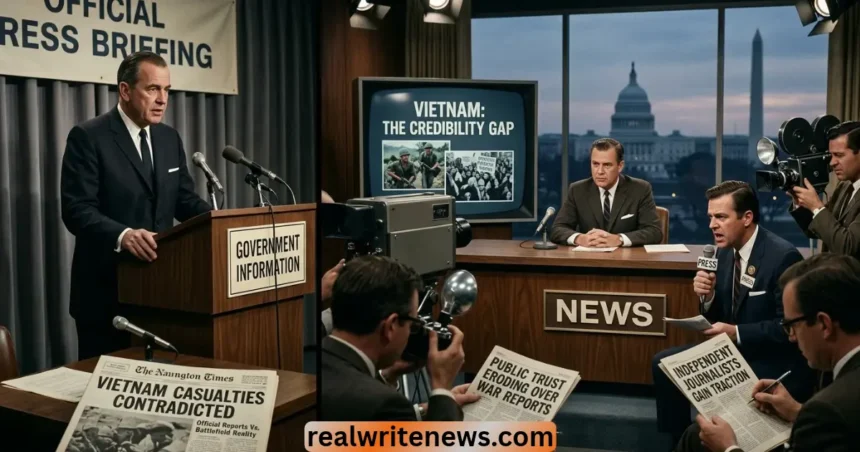
Credibility gap is a phrase used to describe a difference between what someone says and what the available facts, actions, or later events appear to show. The expression can apply to governments, politicians, companies, institutions, journalists, and individuals. Cambridge Dictionary defines it as a difference between what is promised and what actually happens, while Collins describes it as a disparity between statements and evident facts or behavior.
The phrase became especially important in the United States during the 1960s, when journalists and critics used it to describe growing doubts about official statements concerning the Vietnam War. The term became closely associated with the administration of President Lyndon B. Johnson, although its use predates its strongest Vietnam-era association.
This article explains the meaning, origins, historical background, Vietnam connection, role of journalism, and modern use of the credibility gap.
What Is the Credibility Gap?
A credibility gap exists when people notice a meaningful difference between statements and reality. For example, an organization might promise that a project will be completed by a certain date, but repeated delays could make customers question its future promises. The gap does not automatically prove that someone intentionally lied. Sometimes it can result from incomplete information, changing circumstances, poor communication, different interpretations of evidence, or overly optimistic statements.
The phrase therefore focuses on trust and consistency. When words and observable events repeatedly fail to match, audiences may become less willing to accept future statements. In public affairs, this can affect relationships between governments and citizens, officials and journalists, companies and customers, or institutions and their members. The credibility gap is consequently both a communication issue and a question of public confidence.
Credibility Gap Definition and Meaning
The simplest credibility gap definition is the distance between a claim and the reality that people believe they can observe or verify. Dictionaries give slightly different wording, but the central idea remains consistent: statements or promises appear inconsistent with facts, actions, or outcomes.
In American English, the term can also refer to a lack of public confidence in official statements, particularly statements from governments, corporations, and politicians. This broader meaning explains why the expression became prominent in political journalism. A credibility gap can develop gradually. One disputed statement may cause little damage, while repeated contradictions can make audiences question an entire communication system.
Origin of the Credibility Gap
The phrase credibility gap dates to the 1960s, with dictionaries placing its American English origin around 1965–70. Dictionary.com notes that the expression became associated with doubts about government statements during the Vietnam War and later expanded to corporations, individuals, and other institutions.
Historical records also show that the phrase was used before its Vietnam-era popularity. The U.S. Senate Historical Office records an oral-history account in which Pat M. Holt described an earlier dispute involving the Johnson administration as contributing to doubts that later became important during the Vietnam debate. This history shows why it is more accurate to say that Vietnam popularized and transformed the term rather than claiming that the phrase suddenly appeared only because of the war.
Murrey Marder and the Rise of the Phrase
Murrey Marder, a longtime Washington Post correspondent, played an important role in popularizing the expression during the Johnson administration. The National Security Archive describes Marder as the journalist who popularized the term while reporting during the Vietnam era. His phrase referred to the widening distance between the White House’s version of the war and information being reported by journalists in the field.
A later Washington Post historical account states that Marder introduced the term to its readers in December 1965, after which it quickly entered wider public discussion. His reporting helped turn a relatively abstract concern about official statements into a recognizable phrase that readers could use when discussing government credibility.
The Credibility Gap and the Vietnam War
The Vietnam War became the central historical setting for the credibility gap. During the 1960s, U.S. officials frequently presented assessments of military progress, while journalists reporting from Vietnam sometimes encountered information that appeared inconsistent with official accounts. The resulting disagreement contributed to growing skepticism about government statements.
The U.S. Senate’s historical account describes how Senator J. William Fulbright’s Foreign Relations Committee held televised hearings beginning in 1966. According to the Senate, those hearings exposed disputes and deceptions concerning the administration’s presentation of the war and widened what became known as the administration’s credibility gap. The issue therefore extended beyond journalism into Congress and national political debate.
Lyndon B. Johnson and Public Trust
Lyndon B. Johnson, who served as U.S. president from 1963 to 1969, became closely associated with the credibility-gap controversy because of the government’s communication about Vietnam. The issue involved more than one statement or event. It developed from continuing disagreements between official descriptions of progress and information available from journalists, military sources, congressional investigations, and later historical records.
The problem was especially serious because military policy depended partly on public understanding and congressional support. When citizens began questioning official descriptions, later statements faced greater skepticism. A credibility gap can therefore become self-reinforcing: once trust declines, even accurate statements may receive more scrutiny because the audience no longer automatically accepts the speaker’s account.
The Role of Journalism
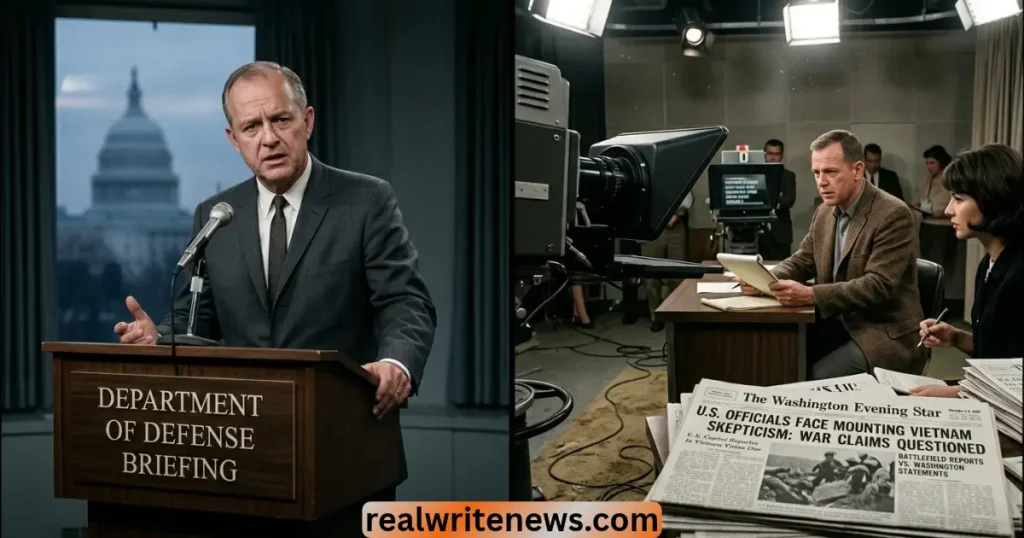
Journalism was central to the development of the credibility gap because reporters could compare official statements with observations from the field. The U.S. State Department’s Office of the Historian includes a detailed discussion of Vietnam-era media coverage in which journalists described differences between official briefings and information they encountered outside official channels.
Television also changed the relationship between the public and distant events. Americans could see images from Vietnam much sooner than audiences had been able to observe earlier wars. This increased the possibility that viewers would compare official descriptions with visual evidence and independent reporting. The result was a more complicated information environment in which government officials, military spokespeople, journalists, and the public interacted continuously.
Television and the Credibility Gap
Television helped make the credibility gap more visible because it brought war footage directly into American homes. Newspapers had long provided detailed reporting, but television offered immediate images that could influence how audiences interpreted official claims. The State Department’s historical conference records show that Vietnam correspondents and officials discussed the difficult relationship between field reporting and government communication.
The Tet Offensive in 1968 became a particularly important moment in this history. Although the offensive caused enormous losses for the communist forces, it also challenged American perceptions about the war’s direction. A contemporary historical analysis published by The Washington Post notes that Tet widened an existing credibility gap by undermining confidence in earlier assurances about progress.
J. William Fulbright and Congressional Hearings
J. William Fulbright, chairman of the Senate Foreign Relations Committee, became another important figure in the history of the credibility gap. Beginning in 1966, his committee conducted televised hearings about Vietnam. According to the U.S. Senate, these hearings examined the administration’s handling of the war and brought disputed information before a national audience.
The hearings mattered because credibility was no longer only a disagreement between reporters and government officials. Congress itself was questioning information about U.S. policy. The hearings also demonstrated how public institutions could investigate executive-branch claims. In this sense, the credibility gap became part of a broader discussion about checks and balances, transparency, oversight, and public accountability.
The Gulf of Tonkin and Credibility
The Gulf of Tonkin Resolution of 1964 is another important part of the historical discussion. The Senate’s historical material explains that later investigations raised serious questions about the administration’s presentation of the events surrounding the reported attacks and the information shared with Congress.
According to the Senate’s account, doubts existed at the time about the reported August 4, 1964 attack, including a cable from the commander of the USS Maddox questioning whether reported contacts and torpedo attacks had actually occurred. These later revelations contributed to congressional and public skepticism about official accounts. The episode illustrates how credibility can depend not only on what officials say but also on what information they choose to disclose.
Why Credibility Gaps Develop
A credibility gap can develop for several reasons. Sometimes officials communicate incomplete information because investigations are still underway. In other cases, organizations may emphasize positive information while minimizing uncertainty or negative developments. Conflicting incentives can also create problems when leaders want to maintain public confidence while journalists or researchers emphasize unresolved facts.
Another cause is simple communication failure. Different departments may use different definitions, data sets, or time periods. A statement that sounds clear to one audience can appear misleading to another. Over time, repeated discrepancies can create distrust. The key point is that a credibility gap describes the relationship between claims and perceived evidence; it does not by itself establish the speaker’s intention.
Credibility Gap vs. Lie
The terms credibility gap and lie should not always be treated as synonyms. A lie normally involves an intentional attempt to deceive. A credibility gap is broader. It describes a situation in which statements are not trusted or appear inconsistent with facts or actions.
For example, an official forecast could prove incorrect because circumstances changed. That could damage credibility without demonstrating that the original forecast was deliberately false. Conversely, documented evidence of intentional deception can produce a credibility gap because people have concrete reasons to distrust later statements. Careful reporting therefore requires separating verified facts, disputed interpretations, errors, and allegations of deception.
Credibility Gap in Politics
Political communication provides many opportunities for a credibility gap to emerge because politicians routinely make promises, explain policies, defend decisions, and respond to changing events. When later actions differ substantially from earlier statements, opponents, journalists, and citizens may describe the difference as a credibility gap.
The phrase is not limited to one political party or ideology. It can be used whenever audiences perceive a meaningful conflict between public claims and subsequent evidence. The important analytical question is therefore not simply whether someone uses the phrase, but what specific statements, actions, dates, documents, or measurable outcomes support the claim of a gap.
Credibility Gap in Business and Organizations
The concept also applies outside politics. A company may advertise a product as reliable while customers report repeated failures. An employer may promise improved workplace conditions but fail to implement announced changes. A nonprofit may promote transparency while providing limited information about its operations.
In these situations, the credibility gap concerns the relationship between promises and performance. Collins specifically defines the expression in general terms as a difference between what a person says or promises and what they actually think or do. This broader use explains why the phrase remains common in business journalism, corporate communication, public relations, and everyday conversation.
How Social Media Changed the Credibility Gap
The digital era has transformed the speed at which credibility gaps can appear. Social media allows statements to spread within minutes, while users can compare posts with videos, documents, photographs, archived pages, and independent reporting. A contradiction can therefore become visible much faster than it could during the newspaper-dominated era.
At the same time, the internet can make verification more difficult. People may encounter edited videos, misleading headlines, incomplete screenshots, or claims repeated without context. As a result, identifying a genuine credibility gap requires more than finding two statements that look different. Researchers should check dates, original sources, context, evidence quality, and whether circumstances changed before reaching a factual conclusion.
How to Identify a Credibility Gap
Identifying a credibility gap requires a structured comparison. Start by recording the original statement and its date. Then identify the action, event, document, or evidence that appears inconsistent with it. Next, check whether the two pieces of information actually address the same issue.
A useful process includes:
- Find the original claim.
- Record when and where it was made.
- Locate independent evidence.
- Compare the claim with later events or documented facts.
- Check whether circumstances changed.
- Distinguish an error from intentional deception.
- Review competing explanations before drawing a conclusion.
This method helps prevent the phrase from becoming a vague accusation rather than a meaningful description.
Why the Credibility Gap Matters Today
The credibility gap remains relevant because trust affects how people interpret information. When an institution has a strong record of accurate communication, audiences may accept uncertainty and corrections more readily. When repeated contradictions occur, future statements may face greater skepticism.
The historical experience of Vietnam demonstrates how communication problems can become larger institutional problems. The U.S. government’s historical records contain examples of officials themselves recognizing the risks associated with a credibility gap. A 1967 CIA communication to the White House explicitly referred to the gap while discussing how military-strength figures might be presented publicly. This is significant because it shows that the issue was recognized inside the government as well as outside it.
How Institutions Can Rebuild Credibility
Closing a credibility gap generally requires consistency between words, evidence, and actions. Institutions can improve trust by clearly distinguishing confirmed facts from estimates, explaining uncertainty, correcting errors promptly, and making supporting documents available when appropriate.
Transparency also matters. When organizations explain why information changed, audiences can better understand whether a contradiction resulted from new evidence or from an earlier mistake. The goal is not simply to produce more statements. Effective credibility depends on whether statements remain consistent with evidence over time.
The historical record shows why this process can be difficult. Once skepticism becomes established, simply issuing another assurance may not restore confidence. Credibility usually depends on demonstrated consistency, not only persuasive language.
Credibility Gap in Modern Language
Today, the phrase credibility gap has moved far beyond its Vietnam-era meaning. Dictionaries now define it broadly enough to cover individuals, companies, governments, institutions, and other organizations.
People may use the phrase when discussing broken promises, disputed statistics, changing corporate policies, inaccurate forecasts, or conflicting public statements. Its continued use reflects a basic human concern: people want a reasonable connection between what they are told and what they can observe.
The expression has therefore survived because it provides a simple way to describe a complex problem involving trust, evidence, communication, accountability, and public perception.
Conclusion
The history of the credibility gap shows how language can emerge from a specific historical period and later become part of everyday communication. The phrase became strongly associated with the Vietnam War and the Lyndon B. Johnson administration, particularly as journalists, members of Congress, and the public questioned differences between official statements and information from other sources.
Its meaning is broader today. A credibility gap can exist whenever people perceive a significant difference between what is promised, what is said, and what actually happens. Understanding the term requires careful attention to evidence and context. A contradiction may reflect deception, but it can also result from error, uncertainty, changing circumstances, or poor communication. That distinction remains essential when evaluating claims in journalism, politics, business, and everyday life.
FAQs About Credibility Gap
What does credibility gap mean?
A credibility gap means a difference between what someone says or promises and what appears to happen in reality. Dictionaries also use the term for a lack of confidence in official statements.
When did the term credibility gap become popular?
The expression became widely associated with American public discourse during the 1960s, especially during the Vietnam War. Dictionary sources place its American English origin around 1965–70.
Who popularized the term credibility gap?
Murrey Marder of The Washington Post is widely credited with popularizing the term during the Johnson administration. The National Security Archive specifically identifies his role in making the phrase widely known.
Why is the Vietnam War connected to the credibility gap?
The term became strongly associated with Vietnam because official statements about the war’s progress were increasingly questioned by journalists, members of Congress, and the public. The issue became especially prominent through congressional hearings and reporting from Vietnam.
Is a credibility gap the same as lying?
No. A credibility gap describes a discrepancy or loss of confidence. It does not automatically prove intentional deception. A statement can become inaccurate because of changing circumstances, incomplete information, or an honest mistake.
Can companies have a credibility gap?
Yes. The term is now used broadly for organizations and companies when their promises or public statements appear inconsistent with their actual performance or behavior.
Why does a credibility gap matter?
A credibility gap matters because repeated contradictions can reduce trust. Once confidence declines, audiences may examine later statements more carefully and demand stronger evidence before accepting them.