


The Tesla Roadster has a special place in electric vehicle history. It helped show that a battery-powered car could offer exciting acceleration, attractive styling, and enough range for more than short city trips. Its story now covers two different chapters: the original production sports car and the long-awaited successor. Understanding that difference matters because searches often mix specifications from different years and versions. This article follows the Roadster’s development, engineering, achievements, and latest announcements. It also explains which figures describe cars customers actually received and which remain manufacturer claims or future plans, giving readers a clear picture of this influential electric sports car.
The Vision Behind the Tesla Roadster
The Tesla Roadster began with an ambitious business idea: introduce electric technology through an expensive sports car before moving toward vehicles for a wider audience. In Tesla’s 2006 master plan, Elon Musk explained that new technology often starts with high costs and becomes more affordable through development and greater production. A desirable performance car could attract early customers while helping support future products. That strategy gave the Roadster a purpose beyond speed or exclusivity. It was an early demonstration of Tesla’s broader intentions. Rather than asking buyers to accept electric driving purely for environmental reasons, the company wanted to make the technology appealing through the driving experience itself.
From Prototype to Production
Tesla first presented the original Roadster prototype on July 19, 2006, and regular production began on March 17, 2008. Moving between those milestones required the company to turn an ambitious demonstration into a vehicle suitable for customers. That distinction is important in the biography of any new car: an attractive prototype does not automatically become a dependable production model. Tesla’s production announcement reported more than 900 reservations and said the 2008 model year had sold out. For the young manufacturer, reaching production provided something stronger than publicity. It created an opportunity for actual owners to experience electric performance and judge the vehicle beyond launch presentations and promotional promises.
Lotus and the Original Sports Car Design
The original Tesla Roadster benefited from a manufacturing relationship with Lotus. Tesla’s filings explain that Lotus helped with design and manufacturing and supplied partially assembled vehicles known as gliders, which did not contain Tesla’s electric powertrain. This arrangement combined an established sports car manufacturer’s capabilities with Tesla’s electrical engineering. It also explains why describing the car simply as a conventional sports car with replacement batteries misses part of its development story. Integrating an electric drivetrain involves packaging, cooling, controls, and structural considerations. The relationship gave Tesla a route into vehicle production while leaving the company responsible for developing the electric systems that defined its product’s identity and driving character.
Battery Technology That Defined the First Generation
The original Tesla Roadster demonstrated the possibilities of combining thousands of small battery cells into an automotive energy-storage system. Tesla’s technical documentation describes a battery containing 6,831 lithium-ion cells, organized into connected groups. The engineering challenge involved much more than fitting cells into an enclosure. A usable vehicle battery also needs electrical protection, monitoring, and systems that regulate how stored energy reaches the drivetrain. This makes the battery central to the Roadster’s importance. It helped move discussion away from whether batteries could power an appealing sports car and toward how manufacturers could improve range, durability, and production. However, specifications from this original system should never be applied automatically to later Roadster concepts.
Original Tesla Roadster Performance
Acceleration helped make the Tesla Roadster memorable. Tesla’s 2009 Roadster Sport announcement listed 0–60 mph in 3.9 seconds for the standard car and 3.7 seconds for the Sport. Those figures gave buyers a clear performance reason to consider an electric vehicle. The Sport also introduced changes including a revised motor design, performance tires, and adjustable suspension components. Its appeal therefore extended beyond a quicker launch from a traffic light. Suspension tuning and tire behavior influence how confidently a sports car responds through corners and over uneven roads. These historical specifications belong to the original generation, making them a useful reference point when evaluating the much more ambitious claims associated with its successor.
Roadster Updates and Interior Improvements
Tesla continued developing the original car after its introduction. The Roadster 2.5, announced on July 1, 2010, brought changes to its appearance, comfort, and equipment. Tesla listed a revised front fascia, a rear diffuser, improved seats, additional sound reduction, and an optional seven-inch touchscreen with a reversing camera. These updates show how customer experience shaped the vehicle alongside engineering ambitions. A sports car needs more than impressive acceleration to remain enjoyable during regular use. Seat support, cabin noise, visibility, and controls all affect ownership. The improvements also make the exact version important when comparing original cars today, because equipment and comfort features can differ across the production history.
Production Numbers and Historical Importance
The original Tesla Roadster was a limited-production vehicle rather than a mass-market model. Tesla’s 2011 annual report recorded approximately 2,150 deliveries across more than 31 countries by December 31, 2011. The same filing stated that the original production run concluded in January 2012, with remaining inventory intended for sale afterward. These dated figures provide a clearer picture than treating every production or delivery number found online as interchangeable. A vehicle can finish its manufacturing run before its last examples reach buyers. The Roadster’s significance also exceeds its sales volume: it gave Tesla practical experience with customers, vehicle development, and electric drivetrains before the company expanded into higher-volume market segments.
The Next-Generation Tesla Roadster Announcement
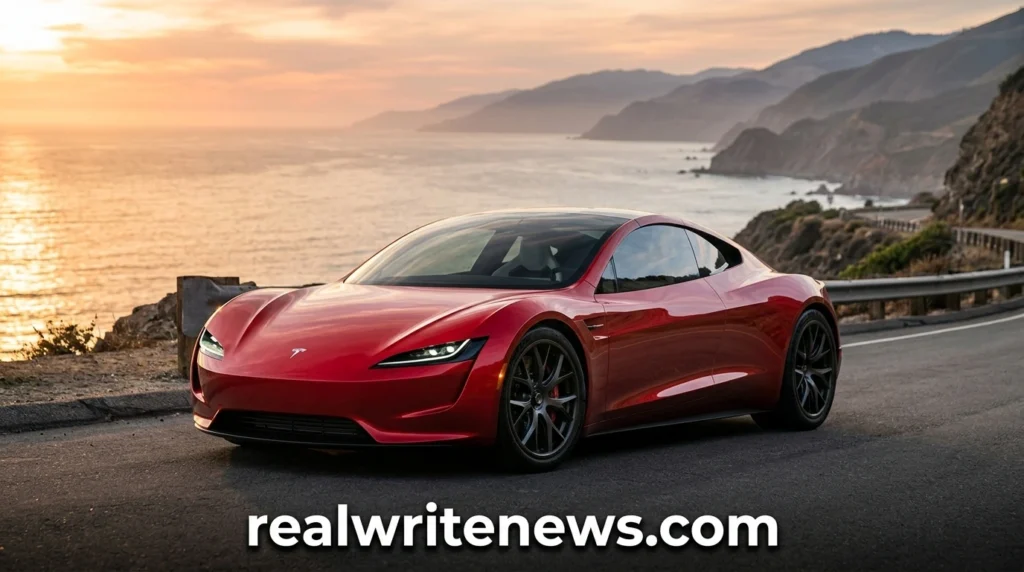
Tesla introduced a proposed next-generation Roadster in November 2017, opening a new chapter for the name. Unlike the original car’s established production history, this chapter involved a concept, ambitious promises, and a lengthy development period. Readers should keep that distinction in mind when researching the Tesla Roadster. A specification presented during an unveiling describes what a manufacturer intends to achieve; it does not automatically establish what a customer vehicle will deliver. The gap between announcement and production also creates room for substantial design changes. Consequently, an article that combines every Roadster announcement into one specification sheet can give a misleading impression of both the original vehicle and its planned replacement.
Understanding the Earlier Performance Targets
Earlier Tesla Roadster marketing advertised 0–60 mph in 1.9 seconds, a top speed above 250 mph, and 620 miles of range. The associated presentation also described four seats and a removable glass roof. These are useful historical reference points, but they require context following the latest redesign. They should not be presented as independently verified results for the newly revealed vehicle or assumed to apply to every future version. Acceleration, maximum speed, range, and practicality are separate characteristics that require separate evidence. A responsible comparison identifies the specific vehicle configuration, the date of the claim, and whether the number comes from manufacturer advertising, a demonstration, or testing of a delivered production car.
Tesla Roadster Latest News in October 2026
The latest major development came on October 15, 2026, when Tesla revealed a redesigned Roadster featuring technology developed with SpaceX. Reuters reported that the white, two-seat demonstration vehicle used thrusters and a suction system during unusual maneuvers, including an airborne jump. The report also said Tesla planned to begin production in 2028. This changes how the car’s development should be described: the newest reveal is an important update to the earlier concept, rather than confirmation that customer deliveries have started. For readers following Tesla Roadster news, the most useful next milestones will be finalized specifications, production readiness, and documented deliveries, alongside the dramatic demonstrations that attract immediate attention.
Range, Charging and Everyday Ownership
Range figures become useful when drivers understand the conditions behind them. For any electric sports car, speed, temperature, route, tire choice, and driving style can affect energy consumption. A headline distance therefore cannot promise the same result on every journey. Charging deserves equally careful attention: buyers need information about connector compatibility, supported charging rates, and the time required under realistic conditions. Historical documentation for the original Roadster describes home and mobile charging equipment, but that information should not be used as a specification for its successor. When assessing the Tesla Roadster, keeping each generation’s charging arrangements separate helps prevent assumptions based on newer Tesla vehicles or unrelated models.
Price, Reservations and Buying Considerations
As of October 16, 2026, a final selling price for the newly revealed Roadster had not been announced in the Reuters reporting reviewed for this article. Readers should therefore treat older price figures and reservation amounts carefully. A deposit is not the same as the complete purchase price, and a reservation does not establish a delivery date. Anyone assessing a Tesla Roadster purchase should read the current agreement for their country and chosen configuration. Buyers considering an original example face different questions, including service records, battery condition, accident history, and access to appropriate repair expertise. Comparing these two buying situations requires more than placing an old advertised price beside a new reservation figure.
Conclusion
The Tesla Roadster’s story connects an influential production sports car with an ambitious successor that continues to evolve. The original model established a tangible record through customer deliveries, documented engineering, and years of ownership. The next chapter has generated attention through increasingly bold design and performance claims, including the October 2026 reveal. Readers benefit most from keeping those chapters distinct while following how they connect. Historical achievements deserve accurate dates, and future capabilities deserve clear attribution. Whether your interest is automotive history, electric vehicle technology, or a possible purchase, the strongest understanding comes from comparing verified specifications, actual ownership needs, and current announcements without treating them as equivalent forms of evidence.
Frequently Asked Questions
What is the Tesla Roadster?
The Tesla Roadster is the name used for Tesla’s original electric sports car and its planned next-generation successor. The first production model was a two-seat convertible that helped introduce the company to customers. Tesla later reused the name for a substantially different performance vehicle. This naming overlap explains why search results can appear inconsistent: one page may describe an original car, another the 2017 concept, and another the latest redesign. Before comparing specifications, identify which version the information covers. Production history, seating, battery technology, price, and availability all depend on that distinction. The name connects the vehicles through their performance-focused purpose, but it does not make their engineering or ownership characteristics identical.
When was the first Tesla Roadster released?
The original Tesla Roadster entered regular production on March 17, 2008, following its prototype unveiling in July 2006. These dates describe different stages of the vehicle’s development, which is why both years appear in historical summaries. An unveiling introduces a design or working prototype, while production marks the start of manufacturing vehicles for the market. Understanding that sequence also helps when reading about the successor. A new reveal does not by itself establish commercial availability. For an accurate timeline, keep prototype presentations, production announcements, individual deliveries, and later updates separate. That approach produces a clearer account of how the original car moved from an ambitious project into the hands of actual owners.
How fast is the Tesla Roadster?
The answer depends on the generation and version. Tesla advertised the original standard Roadster at 3.9 seconds from 0–60 mph, while the original Roadster Sport was listed at 3.7 seconds. Later successor publicity introduced substantially more ambitious performance targets. Those figures should remain separate from the original car’s specifications and from independently measured production results. A meaningful acceleration comparison also needs consistent testing conditions, including the road surface, tires, battery state, and measurement method. For readers, the best practice is to look beyond a single headline number. Identify the exact configuration and whether the result represents an advertised target, a prototype demonstration, or a test of a vehicle available to customers.
Can the new Tesla Roadster fly?
Reports from the October 2026 unveiling describe the demonstration vehicle making short airborne maneuvers using thrusters. That should not be interpreted as evidence that buyers can use it like an aircraft for sustained travel. A controlled demonstration answers a narrower question about what a particular prototype can do under arranged conditions. It does not establish everyday usability, unrestricted operation, or availability of the same capability on every version. Associated Press reporting also stated that the airborne features were not approved for public-road use. Describing the Tesla Roadster as capable of a demonstrated jump is therefore more precise than suggesting it offers ordinary flying-car transportation for future owners in all locations.
Can you still find technical information for the original Roadster?
Yes. Tesla maintains a public Roadster Service Information collection that includes service materials, parts information, electrical references, and owner documentation for several original versions. This is useful because an older specialist vehicle needs information appropriate to its actual equipment. Owners and prospective buyers should identify the correct model version before relying on a manual or maintenance procedure. Documentation can help establish how the vehicle was designed and what checks may be relevant, although reading a manual cannot establish the condition of an individual car. A purchasing assessment still depends on its records and inspection. For the original Tesla Roadster, access to the right information supports more informed conversations with qualified service professionals.
What maintenance should an original Roadster buyer investigate?
A prospective owner should investigate the condition of the vehicle as a complete sports car, including its electric drivetrain. Useful inspection topics include battery behavior, charging operation, cooling equipment, warning messages, brakes, tires, suspension, and evidence of previous repairs. These are inspection priorities rather than a claim that every original Roadster suffers the same faults. Service history matters because it helps explain how a particular example has been maintained and whether significant work has already occurred. Buyers should also establish who can inspect and support the car locally. Tesla’s published manuals provide a reference for its systems, but an individual vehicle’s condition requires direct assessment by someone familiar with the relevant generation and equipment.