

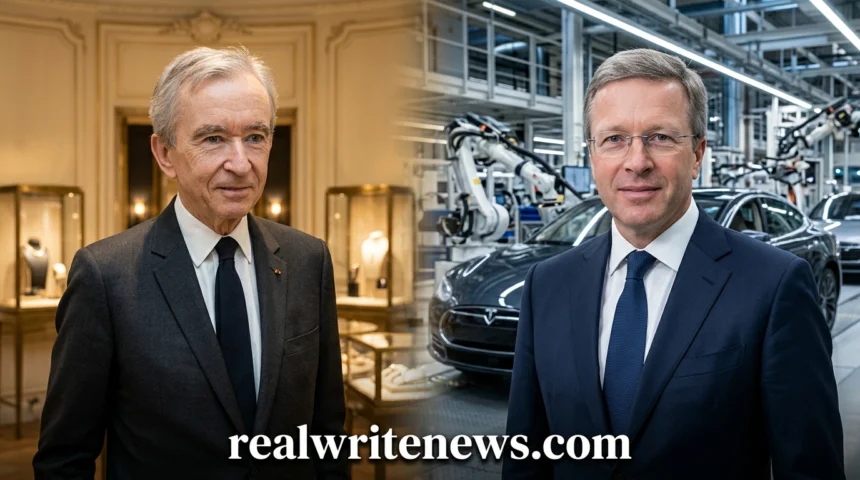
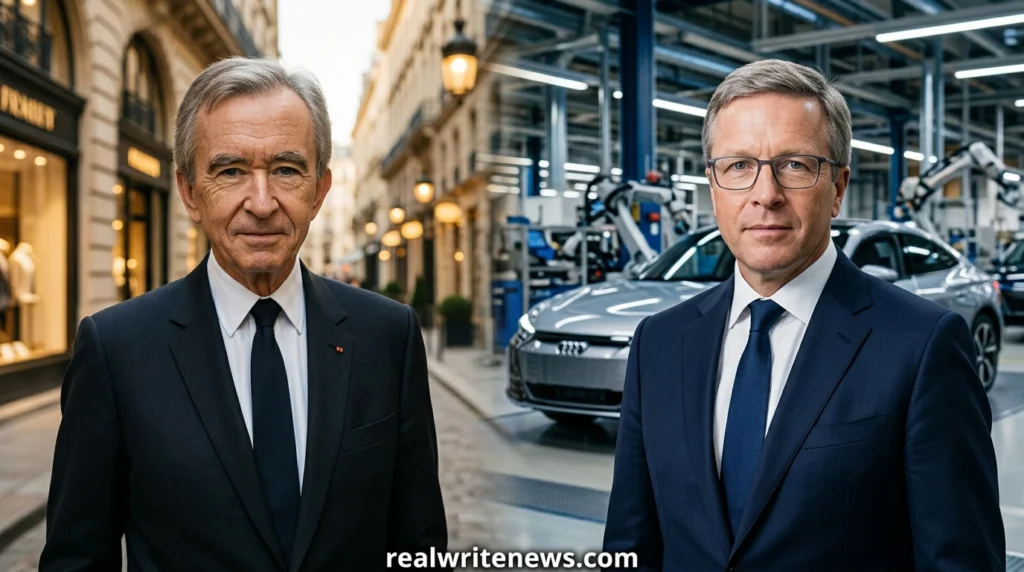
Bernard Arnault and Oliver Zipse built their reputations in different industries, but their careers offer an interesting comparison of global business leadership. Arnault is known for developing LVMH, the luxury group behind Louis Vuitton, Dior and other prestigious houses. Zipse rose through BMW’s engineering and production operations before leading the German carmaker during a major technological transition. Their current positions differ: as of 15 October 2026, Arnault remains LVMH’s chairman and chief executive, while Zipse’s tenure as BMW’s chairman ended on 13 May 2026. This biography examines their backgrounds, career milestones and management approaches, while explaining how each helped shape a business built around premium products.
Bernard Arnault’s Early Life and Education
Bernard Arnault was born on 5 March 1949 in Roubaix, France, into an industrial family. He attended schools in Roubaix and Lille before studying at École Polytechnique, one of France’s leading engineering institutions. His background provides an interesting starting point for someone whose public reputation rests largely on fashion, jewelry and luxury goods. Arnault’s education was technical rather than centered on design or retailing. That distinction helps readers understand his later career: he approached creative businesses through investment, organization and commercial development. His biography demonstrates how an engineering education can support a career extending well beyond traditional industrial work, although education alone cannot explain his subsequent achievements.
From Construction to Christian Dior
Arnault began his professional career as an engineer at Ferret-Savinel, eventually becoming its chairman in 1978. His move toward luxury took shape through the 1984 acquisition of the Boussac group, undertaken with other investors. Boussac owned Christian Dior, giving Arnault an entry into a business with considerable creative heritage and international recognition. Christian Dior’s corporate history identifies this transaction as a central step in the development of the wider group. Looking back, its significance extends beyond acquiring an established name. It placed a fashion house at the center of a broader investment strategy and helped create the foundations for Arnault’s long association with the luxury industry.
Building His Position at LVMH
LVMH was formed in 1987 through the merger of Moët Hennessy and Louis Vuitton. Arnault became its chairman and chief executive in 1989, beginning the long leadership period that defines his public career. Keeping these dates separate is essential: the group’s formation preceded his appointment. Christian Dior’s corporate history also records that it acquired a 32% stake in LVMH in 1988, through a subsidiary, and subsequently increased its interest. These developments show how ownership and management became connected in Arnault’s rise. His story therefore involves more than executive promotion; it includes the patient construction of a corporate structure through which luxury businesses could be controlled, financed and developed internationally.
Acquisitions and the Expansion of Luxury
Acquisitions became a visible part of Arnault’s business record, with Tiffany & Co. joining LVMH in January 2021. LVMH’s completion announcement described the American jeweler as an important addition to its watches and jewelry activities. The transaction illustrates a recurring challenge in luxury management: bringing an established business into a larger organization while maintaining the identity customers recognize. A famous name carries commercial value, but preserving that value requires continued attention to products, stores, craftsmanship and service. Tiffany provides a useful example for understanding Arnault’s approach to expansion. Buying a house creates an opportunity; its lasting contribution depends on what happens after the acquisition, including investment, leadership decisions and the customer’s experience.
Arnault’s Leadership, Creativity and Cultural Interests
LVMH describes its organization as decentralized, allowing individual houses to retain autonomy while benefiting from shared resources. This model helps explain Arnault’s leadership environment: a large group must provide financial discipline without making distinctive brands feel interchangeable. The group also emphasizes craftsmanship, internal growth and control over important stages of production and distribution. Arnault’s cultural interests have a public expression in the Fondation Louis Vuitton, which opened in Paris in October 2014. Supported through LVMH’s corporate patronage, it created a space dedicated to art and cultural exchange. Together, these activities illustrate the relationship between business, creative identity and cultural visibility that makes his career distinctive within international corporate leadership.
Oliver Zipse’s Early Life and Education
Oliver Zipse was born in February 1964 in Heidelberg, Germany. His educational path combined several technical disciplines before expanding into management. He studied computer science and mathematics at the University of Utah, followed by mechanical engineering at Technische Universität Darmstadt. He later earned an Executive MBA through WHU and the Kellogg School of Management. These qualifications provide useful context for his automotive career, which required an understanding of products, factories and business planning. Unlike a biography built around a single entrepreneurial breakthrough, Zipse’s story develops through accumulated technical and managerial experience. His academic background also reflects how modern industrial leadership can bring together engineering knowledge, analytical thinking and an understanding of commercial decision-making.
Rising Through BMW’s Production and Planning Teams
Zipse joined BMW in 1991 as a trainee, beginning a career that would span approximately 35 years at the company. He held positions across development, production and planning, including international responsibilities. His career included managing Plant Oxford and serving in senior technical planning and corporate strategy roles. In May 2015, BMW appointed him to its Board of Management with responsibility for production. The company’s announcement emphasized his experience across its international manufacturing network. These appointments help explain his eventual selection for the top job: he had worked with both factory operations and longer-term business planning. His progression illustrates the importance of operational experience in a company where product promises depend on complex manufacturing systems.
Leading BMW from 2019 to 2026
Zipse became chairman of BMW’s Board of Management in August 2019, a position equivalent to chief executive. His tenure included the COVID-19 pandemic and a period of significant change across the automotive industry. In its account of his departure, BMW credited him with guiding the group through global crises and helping realign its strategy. He completed his board tenure on 13 May 2026, with Milan Nedeljković taking over on 14 May. This transition matters when reading older profiles, some of which still describe Zipse as BMW’s serving chairman. His leadership should now be assessed as a completed chapter, including the decisions made during his tenure and the projects inherited by his successor.
Electric Vehicles and the Neue Klasse Strategy
A defining part of Zipse’s later BMW career was the Neue Klasse, the company’s major vehicle and technology program. At BMW’s 2025 Annual Conference, electrification, technological flexibility and the forthcoming Neue Klasse launch were central themes. Zipse presented the project as a major investment in the company’s future. BMW’s subsequent reporting connected the program with broader changes across its model range, including the introduction of new technologies into additional vehicles. For readers comparing Bernard Arnault and Oliver Zipse, this offers a clear example of industrial renewal. An established premium manufacturer must introduce substantial technical change while preserving the qualities customers already associate with its name, from driving experience to design and perceived quality.
Bernard Arnault and Oliver Zipse: Different Leadership Models
The most useful comparison between Bernard Arnault and Oliver Zipse concerns how their authority developed. Arnault’s career combines corporate leadership with substantial family ownership influence, while Zipse advanced through BMW’s professional management structure. Their responsibilities also operated at different levels of product development. LVMH’s model gives considerable independence to houses with distinct identities; BMW’s leadership must coordinate engineering, manufacturing and product strategy across a tightly connected industrial organization. These differences suggest that effective leadership depends partly on the business being managed. Protecting a fashion house’s creative identity and preparing a manufacturing network for new vehicles require different processes, even when both companies compete through quality, reputation and premium pricing.
Business Performance and the Challenges Behind Prestige
Prestige does not remove economic pressure. LVMH reported revenue of €80.8 billion for 2025, while explaining that its results reflected a disrupted economic and geopolitical environment. BMW reported €133.5 billion in revenue for 2025, alongside approximately 2.46 million passenger vehicles sold. These figures illustrate the scale of the organizations associated with Arnault and Zipse, but they do not provide a simple ranking of managerial success. Luxury goods and automotive manufacturing have different cost structures, investment requirements and measures of demand. A useful comparison considers profitability, resilience, customer appeal and the resources needed for future products. Revenue establishes business size; it does not, by itself, explain the quality or durability of a leader’s decisions.
Conclusion
The careers of Bernard Arnault and Oliver Zipse show two routes to influence within global premium businesses. Arnault’s biography centers on investment, ownership and the development of luxury houses, while Zipse’s follows engineering, manufacturing and professional advancement within BMW. Their experiences suggest several practical lessons: understand the product, protect customer trust and support renewal with sustained investment. Their achievements also need to be understood within the work of wider organizations, including designers, engineers, craftspeople, factory teams and other executives. Comparing them is most valuable when it explains these different responsibilities. Together, their stories offer a broader view of how established brands pursue growth while adapting their products and operations to changing markets.
Frequently Asked Questions
Who Are Bernard Arnault and Oliver Zipse?
Bernard Arnault is the chairman and chief executive of LVMH, the French luxury products group. Oliver Zipse is the former chairman of BMW’s Board of Management, having completed that role in May 2026. Both are prominent European business figures whose careers are closely associated with premium products and international brands. Their professional backgrounds differ considerably: Arnault built his position through investment and corporate control, whereas Zipse rose through automotive engineering, production and planning. Understanding those backgrounds makes their comparison more meaningful. They offer examples of leadership shaped by different industries, ownership arrangements and career paths, rather than a single model that can be applied equally to every large company.
Is Oliver Zipse Still BMW’s Chief Executive?
No. Oliver Zipse’s tenure ended on 13 May 2026, and Milan Nedeljković became chairman of BMW’s Board of Management on 14 May 2026. BMW’s current leadership page confirms Nedeljković’s appointment date. Readers may encounter older biographies, interview introductions or institutional profiles that retain Zipse’s former title, so the publication date and latest company records are important. His past speeches remain useful for understanding BMW’s strategy during his leadership, but they should be presented in their historical context. In a current biography, the clearest description is “former BMW chief executive” or “former chairman of BMW’s Board of Management,” followed by the dates of his tenure where relevant.
Did Bernard Arnault Found LVMH?
LVMH was created in 1987, and Arnault became its chairman and chief executive in 1989. Describing him as the person who developed the group into its later form is more precise than saying he personally established every business within it. The distinction matters because LVMH brings together houses with their own histories, many of which predate the group itself. Its corporate history describes growth through acquisitions alongside support for individual brand identities. Arnault’s central role belongs in that development story: assembling businesses, directing investment and overseeing their expansion. A clear biography therefore separates the original merger, his arrival as leader and the subsequent decades of growth under his management.
What Qualifications Does Oliver Zipse Have?
Zipse’s qualifications include a mechanical engineering degree and an Executive MBA, alongside earlier studies in computer science and mathematics. The Technical University of Munich’s profile records his studies at the University of Utah and TU Darmstadt, followed by the management qualification through WHU and Kellogg. This combination is relevant because automotive leadership spans technical development, manufacturing economics and organizational planning. However, academic credentials tell only part of his story. His career also included years of practical responsibility within BMW’s international operations. Readers looking for career lessons should consider the interaction between education and experience: qualifications provided a foundation, while successive roles exposed him to the decisions and constraints of a large industrial company.
How Do Their Business Strategies Compare?
Arnault’s business environment emphasizes distinct luxury houses, while Zipse’s BMW strategy focused heavily on automotive products, manufacturing capabilities and technological transition. LVMH publicly describes a model that combines brand autonomy with group resources. BMW’s reporting during Zipse’s tenure emphasized electrification alongside a technology-neutral approach that responded to different market conditions and customer needs. Comparing these strategies highlights a shared challenge: investing in change without weakening the appeal of an established name. Their methods differ because their products, development cycles and organizational structures differ. The useful lesson is to connect strategy with the realities of the business, rather than assuming that a successful approach in luxury fashion transfers directly to vehicle manufacturing.
Why Study Bernard Arnault and Oliver Zipse Together?
Studying Bernard Arnault and Oliver Zipse together helps explain how premium businesses combine heritage with renewal. LVMH’s stated mission connects creative development with the preservation of its houses’ identities, while BMW’s Neue Klasse program illustrates an established manufacturer investing in substantial technological change. These examples invite a broader question: how can a company evolve while maintaining the qualities customers value? Their careers provide different perspectives on that challenge, from the allocation of capital across luxury businesses to the coordination of engineering and production. For students, entrepreneurs and general readers, the comparison is useful because it links leadership decisions to products, organizational capabilities and the long-term reputation of a brand.