


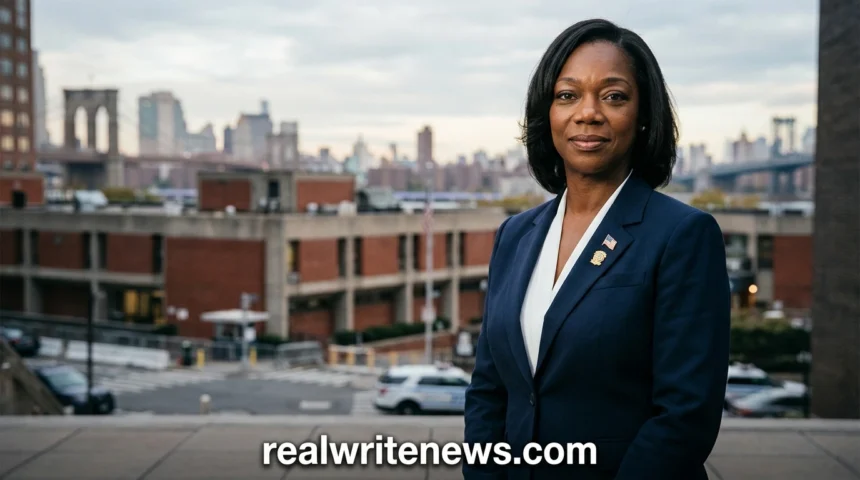
Keechant Sewell made history when she became the first woman to lead the New York City Police Department, but her career reaches well beyond that milestone. Her professional story connects neighborhood policing, detective work, crisis negotiation, executive leadership, and stadium security. Understanding Keechant Sewell means looking at both the experience that brought her to national attention and the difficult environment she encountered in New York. Her appointment created new possibilities for representation at the top of American policing, while her brief tenure raised questions about authority, accountability, and institutional change. This biography follows the documented stages of her career and places her achievements alongside the challenges that shaped her public service.
Keechant Sewell’s Early Life in Queens
Queens, New York, provides the starting point for Keechant Sewell’s story. Her first home was Queensbridge Houses in Long Island City, the public housing development where officials later introduced her as the incoming police commissioner. That connection gave the announcement a personal dimension: a woman who had lived in the neighborhood was returning to accept responsibility for policing the entire city. Keechant Sewell’s background also helps explain why her appointment resonated beyond police headquarters. Her career linked a familiar New York community with an institution whose decisions affect millions of residents. The setting offered a clear reminder that public leadership can begin far from the offices where major appointments are announced.
Starting a Law Enforcement Career in 1997
Keechant Sewell joined the Nassau County Police Department in 1997, beginning a career that would eventually take her into senior command. Her early assignments included patrol in the Fifth Precinct in Elmont, a community on Long Island near the Queens border. For readers following her rise, this starting point matters because patrol places officers close to the everyday situations that shape public confidence in policing. Responding to calls, working with colleagues, and communicating with residents create a foundation for later responsibility. Keechant Sewell did not enter public life through an immediate executive appointment. Her advancement followed years of practical police work before she became a widely recognized leader.
Community Work and Investigative Assignments
Early in her career, Keechant Sewell served as a school resource officer and as a police liaison to the Wayside Home for Girls. She later worked undercover and became a detective assigned to the First Squad in Baldwin. These assignments brought together community contact and criminal investigation, two areas that require different but complementary abilities. Working with young people calls for patience and communication, while investigations demand careful attention to evidence and detail. In considering Keechant Sewell’s professional development, the variety is significant. Her background did not rest on one narrow specialty; it included responsibilities involving prevention, investigation, and relationships with people who encountered the police under very different circumstances.
Hostage Negotiation and Professional Training
Hostage negotiation became another important part of Keechant Sewell professional identity. Her public speaker biography describes her as an FBI-trained hostage negotiator who rose to become Nassau’s chief negotiator. It also identifies her as a graduate of the 235th session of the FBI National Academy, where her peers selected her to deliver the class commencement address. These qualifications show a substantial investment in leadership and communication training. For Keechant Sewell, negotiation added experience in situations where words, timing, and restraint could be central to the response. The broader leadership lesson is clear: managing a crisis requires listening and judgment alongside the ability to make and communicate difficult decisions.
Becoming Nassau County’s Chief of Detectives
In 2020, Keechant Sewell became Nassau County’s chief of detectives, a senior appointment that preceded her move to New York City. Nassau County later recognized her career during a Women’s History Month ceremony, highlighting the importance of her advancement. Reaching the top of a detective division involves a different level of responsibility from handling individual investigations: senior leaders must help teams work together, maintain standards, and manage competing demands. Keechant Sewell’s promotion therefore represented an important bridge between her operational experience and the much larger executive role ahead. It also made her part of a wider discussion about who receives opportunities to lead major law enforcement organizations.
A Historic Appointment as NYPD Commissioner
Mayor-elect Eric Adams introduced Keechant Sewell as his choice for police commissioner in December 2021. She took office on January 1, 2022, becoming the 45th NYPD commissioner and the department’s third Black commissioner. The appointment placed an experienced Long Island police leader at the head of the nation’s largest municipal police force. Associated Press reporting noted that she was the first commissioner appointed from outside the department in more than two decades. Keechant Sewell consequently arrived with both an outsider’s perspective and the task of earning confidence inside a deeply established institution. Her selection was historic, but the responsibilities immediately extended beyond the symbolism of being first.
Facing Crisis in Her First Month
Keechant Sewell’s introduction to the commissioner’s office came with little time for adjustment. Associated Press reporting described an officer shooting within hours of her swearing-in, followed later that month by the fatal shooting of two officers. Those events placed grief, public communication, and officer welfare near the center of her earliest responsibilities. A police commissioner must address the immediate operational response while also speaking to families, colleagues, and a city looking for reliable information. For Keechant Sewell, the beginning of the job demonstrated how quickly executive leadership can become personal. The challenges were not simply administrative; they involved human loss and the need to lead an organization through uncertainty.
Public Safety and Community Relationships
In a 2023 interview with amNewYork, Keechant Sewell described an interest in making everyday encounters with the police more service-oriented. Recalling her Nassau experience, she spoke about practical assistance to residents and the importance of helping people feel connected to their department. This perspective adds useful detail to a biography often dominated by appointments and crime statistics. It shows how Keechant Sewell explained her own priorities beyond enforcement. Community relationships depend partly on ordinary interactions: whether people receive clear information, feel heard, and understand how to seek help. Her stated approach placed those experiences within the wider public safety mission, although expressing a goal does not by itself establish its success.
Understanding the Crime Statistics Under Sewell
The crime record during Keechant Sewell’s tenure requires careful explanation. In its original year-end release, the NYPD reported that murders fell 11.3% and shooting incidents fell 17.2% in 2022 compared with 2021. However, the same release reported a 22.4% rise in overall major index crime. These figures describe different measures and should appear together when assessing that year. They do not support a simple claim that every major crime problem improved. Nor can citywide trends establish how much change resulted from one official’s decisions. Keechant Sewell led during a period with meaningful reductions in gun violence alongside continued difficulties across the broader major-crime picture. The comparison period matters.
Leadership, Innovation and Accountability
Another documented part of Keechant Sewell’s leadership was the Innovation Steering Committee, which her professional biography credits with producing nearly 250 recommendations. The proposed improvements covered areas including data analysis, technology, community engagement, and officer safety. Recommendations indicate what an organization wants to improve, although they should not be confused with independently verified outcomes. Keechant Sewell’s tenure also illustrates a wider challenge for police executives: operational efficiency and accountability must develop together. Better information can help leaders allocate resources, but meaningful evaluation still requires questions about fairness, implementation, and public confidence. The significance of an initiative ultimately depends on what changes in practice and how clearly those changes can be assessed.
Why Keechant Sewell Left the NYPD
Keechant Sewell announced her resignation on June 12, 2023, and her departure took effect at the end of that month. Her time as commissioner lasted approximately 18 months. Contemporary reporting described questions about her authority and reported tensions involving City Hall, while a mayoral spokesperson disputed reports of friction. Importantly, Keechant Sewell’s resignation message did not publicly provide a detailed explanation for leaving. A responsible biography must preserve that distinction between reported circumstances and her own confirmed account. Her departure prompted debate about the independence of a police commissioner within a mayoral administration, but presenting a single private motive as established fact would go beyond the public evidence.
Keechant Sewell’s Career With the New York Mets
The Mets announced Keechant Sewell’s appointment on November 2, 2023, with a November 27 start date.Their current directory lists Keechant Sewell as Senior Vice President, Security, Guest Experience & Ballpark Operations. [11] The move connects her security background with the experience of people attending a major sports venue. In general, venue leadership brings together emergency preparation, access, staff coordination, and the practical needs of visitors. That combination helps explain why experience from public safety can be relevant in professional sports. This assessment describes the connection between the fields rather than claiming particular operational results at Citi Field. Her post-policing career demonstrates that executive security work extends beyond government service.
Conclusion
Keechant Sewell’s biography follows a clear professional arc: early police assignments, senior investigative leadership, a historic NYPD appointment, and a subsequent career in sports venue leadership. Her place in New York history rests securely on becoming the department’s first woman commissioner. Assessing her broader record requires more than that distinction, including attention to mixed crime trends, organizational initiatives, and the limits of publicly available explanations for her departure. Keechant Sewell remains an important figure in discussions about women in leadership and the demands of public service. Her career also shows why a useful biography should connect milestones with context, recognizing achievement while allowing readers to understand complexity and judge the evidence for themselves.
Frequently Asked Questions
Who Is Keechant Sewell?
Keechant Sewell is an American law enforcement and security executive, best known for becoming the first woman to serve as New York City’s police commissioner. Before that appointment, she built her career in Nassau County, progressing through patrol, investigative, supervisory, and command responsibilities. Her public profile reflects both the historical significance of her appointment and the practical experience behind it. When reading about Keechant Sewell, it is helpful to distinguish her former government position from her later executive career. Describing her only as a former commissioner leaves out the earlier work that prepared her for leadership and the professional responsibilities she took on after leaving the police department.
What Made Her NYPD Appointment Historic?
Keechant Sewell broke a gender barrier when she became the first woman to lead the NYPD, while also becoming its third Black commissioner. Those distinctions matter because leadership appointments influence public expectations about access to senior positions. They can also give younger officers and potential applicants a visible example of a career path previously absent from an institution’s history. However, the significance of Keechant Sewell’s appointment should be understood alongside her qualifications and the work the office required. Representation explains why the appointment attracted attention; operational leadership explains why her decisions mattered to residents and officers. Both belong in an accurate account of her place in New York’s policing history.
When Did Keechant Sewell Serve as Commissioner?
Keechant Sewell served as NYPD commissioner from January 2022 through June 2023, a period of approximately a year and a half. The distinction between appointment, taking office, announcing a resignation, and leaving office helps prevent confusion in career summaries. Her selection became public in December 2021, but her service began the following January. Similarly, the June resignation announcement preceded the effective end of her tenure. For anyone preparing a timeline of Keechant Sewell’s career, these separate stages should remain clear. A brief tenure can still encompass major responsibilities, and its length alone does not explain either the full circumstances of the appointment or the reasons behind a departure.
Did Crime Fall While She Led the NYPD?
Some crime measures fell, while others rose, so the answer depends on the category and dates being compared. The NYPD’s initial report for 2022 showed reductions in murders and shootings alongside an increase in overall major index crime compared with 2021. Keechant Sewell’s record should therefore be described with those differences intact. A monthly improvement, a year-to-date comparison, and a full-year result can produce different headlines without necessarily contradicting one another. It is also important to remember that preliminary police statistics can later change. When assessing Keechant Sewell’s tenure, readers should check the measure, reporting period, and source before accepting a broad claim that crime either increased or decreased across the board.
What Is Keechant Sewell Known for Beyond the NYPD?
Beyond her historic appointment, Keechant Sewell is associated with hostage negotiation, investigative leadership, and professional speaking about security and management. Her speaker profile discusses subjects such as negotiation, consensus building, and teamwork under pressure. Industry coverage also announced her as a keynote speaker for the 2024 Securing New Ground conference, reflecting interest in her experience across public and private security. These activities help explain the broader relevance of Keechant Sewell’s career. Leading people, communicating during uncertainty, and coordinating institutions are challenges shared by many organizations. Her professional story consequently offers material for discussions about executive responsibility that extend beyond the history of one police department or a single high-profile appointment.