


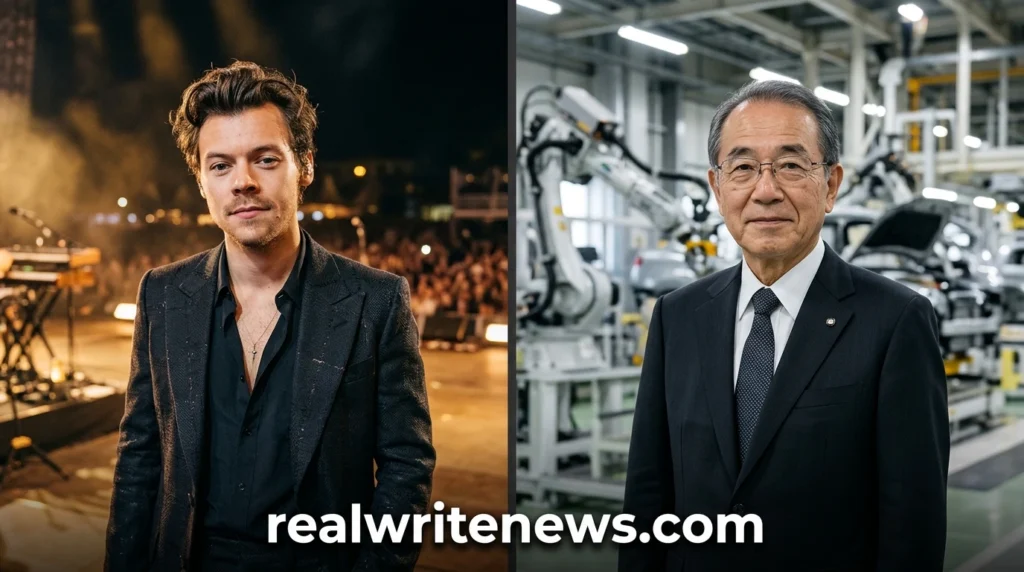
Harry Styles and Masamichi Kogai have built successful careers in very different worlds. Styles is an English singer, songwriter and actor whose journey began with television auditions and international pop fame. Kogai is a Japanese automotive executive best known for serving as Mazda’s president, CEO and later chairman. Their biographies offer two perspectives on professional growth: one through creative performance, the other through manufacturing and corporate leadership. This article examines their backgrounds, major achievements and career transitions. It treats their stories as a comparison, since the reliable sources reviewed do not establish a personal relationship or professional collaboration between them.
Harry Styles’ Early Life and Interest in Music
Harry Edward Styles was born on February 1, 1994, and grew up in Holmes Chapel, Cheshire, England. Before international recognition, he attended school and performed with a local band called White Eskimo. These early experiences gave him opportunities to sing with other musicians and develop confidence in front of an audience. In 2010, at sixteen, he auditioned for the British television competition The X Factor. That appearance became the turning point in his public career. His beginnings illustrate how local performances can prepare a young artist for a much larger opportunity, even when the eventual route to success takes an unexpected direction.
One Direction and the Foundations of Global Fame
Styles became internationally known as a member of One Direction, the group formed during The X Factor in 2010. Its original lineup also included Niall Horan, Zayn Malik, Liam Payne and Louis Tomlinson. The band released five studio albums, beginning with Up All Night in 2011 and ending with Made in the A.M. in 2015. Songs such as “What Makes You Beautiful,” “Story of My Life” and “Night Changes” helped define its musical identity. For Styles, these years provided experience in recording, touring and performing within a team. They also created the audience foundation from which he would later develop his independent artistic career.
Harry Styles’ Move into a Solo Career
Launching a solo career required Styles to establish a musical identity beyond the expectations surrounding One Direction. His self-titled debut album arrived in 2017, with “Sign of the Times” introducing a sound influenced by rock and expansive pop songwriting. Both the album and its lead single reached Number One in the United Kingdom. His second album, Fine Line, followed in 2019, bringing songs including “Adore You,” “Lights Up” and “Watermelon Sugar.” Together, these releases showed that his appeal could extend beyond his earlier group membership. His development also demonstrates how an established performer can retain familiar strengths while gradually changing sound, presentation and creative direction.
Grammy Awards and the Success of Harry’s House
A major milestone came when “Watermelon Sugar” won Best Pop Solo Performance at the 2021 Grammy Awards. Styles later released Harry’s House in 2022, strengthening his reputation as a successful solo recording artist. At the 2023 Grammy Awards, that album won both Album of the Year and Best Pop Vocal Album. These honors marked an important stage in his transition from boy-band fame to individual recognition. They also provide a clear, verifiable way to describe his achievements without relying on vague claims about popularity. The awards belong within a broader career story involving songwriting, production partnerships, live performance and the continued development of his musical identity.
Acting, Fashion and a Wider Creative Identity
Music remains central to Styles’ public career, but his work also extends into acting and fashion. In My Policeman, he played Tom, a policeman whose relationships unfold against restrictive social expectations in twentieth-century Britain. His fashion activities include Gucci HA HA HA, a collection developed with then creative director Alessandro Michele. Gucci describes the project as emerging from their friendship and shared interest in playful self-expression. These activities show how his professional identity reaches across several creative fields. Each medium asks something different of him: a recording communicates through sound, a screen role through character, and a fashion collaboration through clothing, imagery and visual storytelling.
Harry Styles’ Latest Verified Career Developments
An updated biography must include Kiss All the Time. Disco, Occasionally., Styles’ fourth solo studio album, released on March 6, 2026. Sony Music’s release announcement identifies Kid Harpoon as its executive producer and confirms a twelve-track collection featuring “Aperture” and “American Girls.” The release opened another chapter after Harry’s House, giving readers a more current picture than biographies that stop at his 2023 awards. Its arrival also illustrates the rhythm of an established recording career, in which writing, recording and promotion lead into another period of public activity. As of this article’s update, the fourth album is an essential part of his published discography.
Masamichi Kogai’s Background and Entry into Mazda
Masamichi Kogai was born on August 24, 1954, according to Mazda’s official executive biography. He joined Toyo Kogyo, the company now known as Mazda Motor Corporation, in April 1977. His professional story therefore began decades before his appointment to the company’s highest executive position. Unlike a performer whose early career may be documented through interviews and public appearances, Kogai’s available biography is largely a record of corporate responsibilities. That record offers a useful starting point: his leadership developed through sustained work inside the automotive industry. Understanding this long internal progression helps explain why production and operational knowledge became central features of his later executive profile.
Production Experience and Increasing Responsibility
Kogai’s advancement included positions in production engineering, manufacturing management and international operations. Mazda’s career record lists him as general manager of its Painting, Trim and Final Assembly Engineering Department in 1998, followed by further production engineering responsibilities. He became general manager of the Hofu Plant in 2004 and president of AutoAlliance (Thailand) in 2006. These appointments show a career closely connected to how vehicles are actually built. They help explain the operational perspective he brought to leadership: manufacturing decisions influence quality, cost and delivery long before a customer visits a showroom. His experience offers a practical example of executive development through increasingly demanding responsibilities within a complex industrial organization.
Thailand and Mazda’s International Manufacturing Network
Thailand provides a concrete example of the international manufacturing priorities associated with Kogai’s leadership. At the August 2015 opening ceremony for Mazda Powertrain Manufacturing Thailand, he described the country as an important strategic market and production base. His speech explained that the facility would supply core components, including engines and transmissions, to Mazda operations across several countries. He also highlighted cooperation between Japanese and Thai employees in establishing production capability. This account helps readers understand automotive expansion beyond the simple opening of another factory. A production network must connect people, equipment and component supply across borders, making coordination and consistent manufacturing standards essential to the wider company’s ability to serve customers.
Becoming Mazda’s President and CEO in 2013
Kogai became Mazda’s president and CEO in June 2013, succeeding Takashi Yamanouchi in those roles. Mazda’s announcement placed the change within an existing period of recovery and structural reform. The company stated that it had returned to profitability and wanted renewed leadership to pursue further growth. This context matters because it prevents an overly simple account in which one executive receives credit for every improvement. Kogai inherited ongoing initiatives and worked within a broader management structure. His appointment nevertheless marked a significant personal achievement, moving him from oversight of production-related functions into responsibility for the direction of the whole business, including its commercial priorities and long-term development.
Technology, Brand Value and Customer Experience
In an August 2017 technology briefing, Kogai explained Mazda’s ambition to build stronger emotional connections with customers through driving pleasure, design and practical vehicle performance. His remarks discussed SKYACTIV technology, KODO design and manufacturing approaches intended to support an extensive product range with limited resources. These priorities reveal how technical decisions and brand positioning intersected during his presidency. The underlying idea was that customers should experience value throughout ownership, encouraging repeat purchases and recommendations. This provides a more specific understanding of his management outlook than describing him simply as an innovative executive. It links the company’s engineering and production work to the everyday experience Mazda wanted its customers to have.
The Toyota–Mazda Alliance Under Kogai
One of the most significant corporate developments during Kogai’s presidency was the Toyota–Mazda business and capital alliance announced on August 4, 2017. The agreement covered plans for joint vehicle production in the United States, cooperation on electric vehicles, connected-car technology and advanced safety systems. It also established a capital relationship while emphasizing the companies’ independence. Kogai represented Mazda in the announcement alongside Toyota president Akio Toyoda. The partnership illustrates a central challenge for automotive leaders: developing increasingly complex technologies while managing resources and preserving a company’s identity. It also demonstrates that corporate achievement often depends on negotiated cooperation between organizations, rather than decisions made by a single leader working alone.
From Mazda Chairman to Former Executive
Kogai moved from president and CEO to chairman of Mazda’s board in June 2018, while Akira Marumoto became president and CEO. His chairmanship subsequently ended with Mazda’s leadership changes in June 2021, when Kiyotaka Shobuda succeeded him. This distinction is especially important when reading older biographies, because Mazda’s archived Kogai profile still displays the title he held when that page was updated. The company’s current executive listing, dated July 1, 2026, identifies Shobuda as chairman and Masahiro Moro as president and CEO. An accurate present-day description should therefore call Kogai a former Mazda president, CEO and chairman, rather than present an archived title as his current position.
Conclusion: Understanding Harry Styles and Masamichi Kogai
Harry Styles and Masamichi Kogai offer contrasting examples of how professional reputations develop. Styles’ career follows the visible progression from group performance to solo recordings and broader creative work. Kogai’s follows a long internal journey through automotive operations into executive leadership. Their achievements require different measures, and comparing them is most useful when those differences remain clear. Awards and albums explain important parts of Styles’ story; appointments, manufacturing responsibilities and corporate agreements explain Kogai’s. The shared lesson is an interpretation of their careers: sustained progress often involves learning, collaboration and adapting to larger responsibilities. Their biographies remain distinct, and neither needs an invented connection to make the comparison informative.
FAQ: Are Harry Styles and Masamichi Kogai Related?
No reliable source reviewed for this article establishes a family relationship between Harry Styles and Masamichi Kogai. Their names can appear together as the subject of a comparative article, but that does not demonstrate a real-world connection. The available authoritative material documents different professional histories: Styles’ recording career and Kogai’s work in automotive leadership. Readers should distinguish between a page placing two names together and evidence that those people share a relationship. If a publication claims they are relatives, friends or business partners, the claim needs its own supporting documentation. Without that evidence, the accurate approach is to describe them separately and explain the purpose of any comparison.
FAQ: Have Harry Styles and Masamichi Kogai Worked Together?
No verified collaboration between them was identified in the sources reviewed. There is no established joint project in this article’s evidence base connecting Styles’ music or fashion activities with Kogai’s Mazda leadership. Their documented partnerships instead involve other people and organizations: Styles worked with Alessandro Michele on Gucci HA HA HA, while Kogai represented Mazda in its alliance with Toyota. These are separate professional relationships. A comparison may explore teamwork, branding or international reach across both careers, but those themes are analytical similarities. They should not be presented as proof of a shared business venture, endorsement agreement or personal association between the two individuals.
FAQ: What Are Harry Styles’ Biggest Career Achievements?
Styles’ major achievements include building a solo recording career after One Direction, releasing successful albums and receiving Grammy recognition. His progression is particularly clear when viewed across his discography: the debut established his independent sound, Fine Line expanded his musical range, and Harry’s House brought major album honors. His fourth album added another chapter in 2026. Rather than reducing his career to a single trophy or song, it is more useful to consider these stages together. They show both commercial visibility and continued creative activity. His acting and fashion work broaden the picture further, although music remains the main foundation of his international professional reputation.
FAQ: What Is Masamichi Kogai Best Known For?
Masamichi Kogai is best known for his former leadership roles at Mazda, especially his presidency and subsequent chairmanship. His career is also notable for its roots in manufacturing, which provide context for his approach to automotive management. For readers unfamiliar with corporate titles, the distinction between his positions matters. A president and CEO generally leads executive management, while a chairman leads the board’s work within the company’s governance structure. Moving between those roles represents a change in responsibility rather than simply a new name for the same job. His biography is therefore best understood as a sequence of operational, executive and board-level responsibilities across several decades.
FAQ: Is Masamichi Kogai Still Mazda’s CEO or Chairman?
No. Kogai is neither Mazda’s current CEO nor its current chairman. As of the company’s executive listing dated July 1, 2026, Masahiro Moro holds the president and CEO position, and Kiyotaka Shobuda serves as chairman. Confusion can arise because older official pages remain accessible and accurately describe the positions Kogai held at their publication dates. The solution is to check the date alongside the title and compare archived biographies with the current leadership page. This is particularly useful when researching executives whose careers involve several senior appointments. For a current biography, Kogai’s former roles should always be identified with the appropriate historical context.